Why Spring Is Critical for Waterfront Property Maintenance
If you own waterfront property along the Intracoastal Waterway, on a canal, or on one of Palm Beach County's many lakes, April marks an important transition. Water temperatures are climbing past 80 degrees, and that warmth triggers explosive growth of algae, barnacles, and marine organisms on every submerged and water-adjacent surface.
Your dock and seawall are under increasing biological assault right now. What was manageable growth over the cooler winter months is about to accelerate dramatically through summer. Addressing it in spring—before growth peaks—is easier, less expensive, and protects your structures heading into storm season.
The Hidden Costs of Neglecting Your Dock and Seawall
Safety Hazards
Algae-covered dock surfaces are dangerously slippery when wet. A slip on an algae-coated dock can mean falling into the water, hitting a piling, or landing on a hard surface. For families with children or elderly visitors, this is a serious liability.Structural Degradation
Marine growth actively degrades the structures it colonizes:- Barnacles bore into wood and weaken concrete over time
- Algae roots penetrate wood grain, accelerating rot
- Thick growth layers trap moisture against surfaces, promoting decay
- Salt crystallization under the growth deteriorates concrete and mortar joints
Property Value Impact
A dirty, growth-covered seawall and deteriorating dock are immediately visible from the water—and in listing photos. For waterfront properties where the water view and dock are primary selling features, neglected marine structures significantly reduce perceived value.Accelerated Wear on Seawall Caps
Seawall caps (the concrete or stone top edge) collect organic growth that retains moisture and promotes cracking. Once cracks form, water infiltration accelerates deterioration from the inside out. Cap replacement is expensive—$50-100+ per linear foot.What Professional Dock and Seawall Cleaning Includes
Dock Surface Cleaning
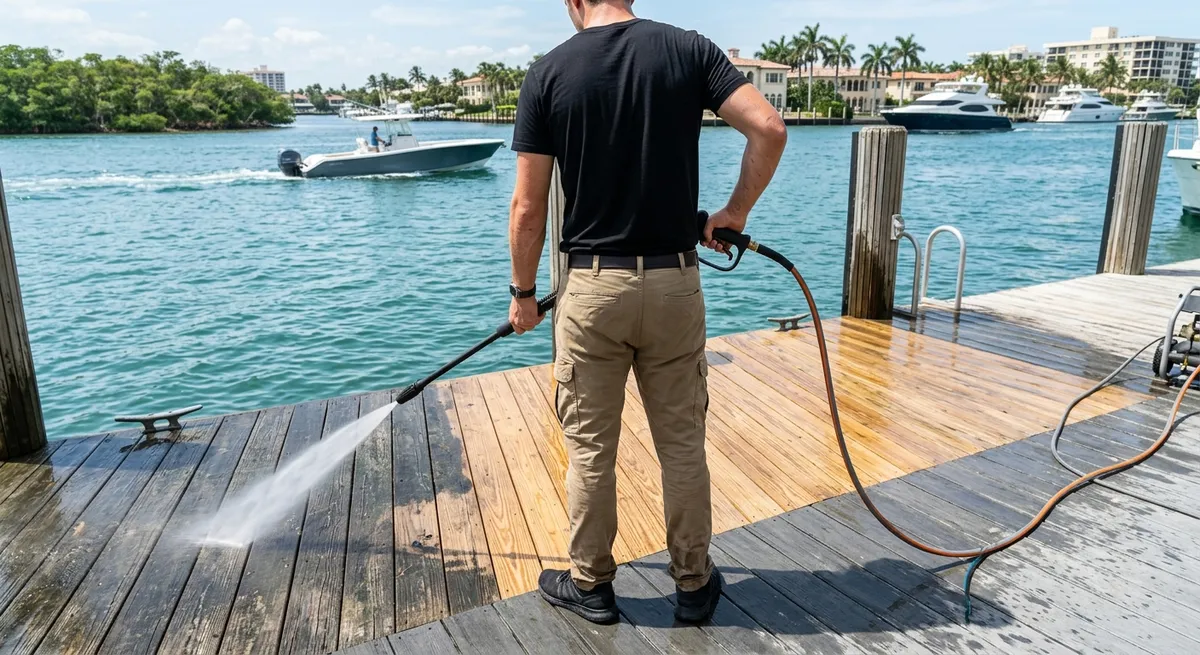
We clean dock walking surfaces using low to moderate pressure adjusted for the specific decking material:- Composite decking gets moderate pressure with surface cleaners for even results
- Pressure-treated wood needs low pressure with cleaning solutions to avoid grain damage
- Ipe and hardwoods get pressure matched to the wood density, plus protective treatments
- Concrete docks can handle standard pressure washing
Piling Treatment
Dock pilings accumulate heavy marine growth below the waterline and algae/mold above it. We clean exposed piling surfaces to remove growth and inspect for structural issues like splitting, marine borer damage, or failed wrapping.Seawall Face Cleaning
Seawall faces collect dense algae growth, waterline staining, and mineral deposits. Professional cleaning restores the appearance and allows you to inspect the seawall surface for cracks, spalling, or joint deterioration that might need repair.Seawall Cap Cleaning
The horizontal cap surface collects organic debris, mold, and staining. Cleaning reveals the true condition of the cap and removes growth that accelerates deterioration.How Often Should Palm Beach Waterfront Owners Clean Their Dock?
The answer depends on your specific waterfront conditions:
Intracoastal properties: Every 2-3 months during warm months (April-October), quarterly during cooler months. Tidal flow brings constant new biological material. Canal properties: Every 3-4 months. Less tidal influence means slower growth, but still significant in warm months. Lakefront properties: Every 4-6 months. Freshwater environments generally produce less aggressive marine growth than saltwater. Factors that increase frequency:- Heavy shade over the dock (stays damp longer)
- East-facing seawalls (more algae sun exposure)
- Properties near inlets (more marine organism traffic)
- Docks used for fish cleaning (attracts more biological activity)
Your Spring Dock and Seawall Inspection Checklist
Beyond cleaning, spring is the time for a thorough inspection. Walk through each of these:
Structural Elements
- [ ] Check pilings for splitting, leaning, or marine borer damage
- [ ] Inspect dock framing connections for looseness or corrosion
- [ ] Look for any boards that flex excessively or feel soft (rot indicator)
- [ ] Check that cleats, ladders, and hardware are securely fastened
Seawall Assessment
- [ ] Examine the seawall face for cracks, spalling, or holes
- [ ] Check the cap for cracks or separation from the wall
- [ ] Verify weep holes are clear and draining (clogged weep holes cause hydrostatic pressure buildup)
- [ ] Look for soil erosion behind the seawall (visible sinkholes or settling near the wall)
- [ ] Check the seawall tiebacks if accessible
Dock Systems
- [ ] Test all electrical outlets and dock lighting (GFCI protection is critical)
- [ ] Check boat lift cables, pulleys, and mechanisms
- [ ] Inspect dock bumpers and fender boards
- [ ] Verify the dock is level and not settling on one side
Pre-Storm Readiness
- [ ] Identify anything that should be removed before a storm (loose items, canvas covers)
- [ ] Know where your dock lines are and their condition
- [ ] Have a plan for your boat lift in a storm approach
Why Spring Cleaning Sets You Up for Summer
Tackling dock and seawall cleaning in April provides several advantages:
Growth is still manageable. Winter's cooler water temperatures kept growth rates down. Cleaning now is faster and less labor-intensive than waiting until midsummer when growth is thick and heavily established. You're ready for summer use. Boating season, entertaining on the dock, fishing, and water activities all ramp up in late spring. Start the season with a clean, safe dock. Storm readiness. Clean surfaces let you see the true condition of your structures. Identifying a cracked seawall cap or weakened piling in April gives you time to repair before hurricane season. Maintenance schedule kickoff. Starting your cleaning schedule in spring and maintaining it quarterly keeps your waterfront structures in the best possible condition year-round.Protect Your Waterfront Investment
Last spring we cleaned a dock in Jupiter where the homeowner had been walking on algae-covered boards for two seasons, assuming it was just staining. The surface was slippery enough that we flagged it before we started. After the cleaning we pointed out a section of decking that had gone soft underneath the biofilm -- it looked fine from the surface, but it wasn't load-bearing anymore. He got it replaced before anyone put a foot through it.
Waterfront properties in Palm Beach County command a significant premium—and that premium depends partly on the condition of your dock and seawall. Regular professional cleaning protects both the structures themselves and the property value they support.
We provide dock and seawall cleaning for waterfront homes throughout Palm Beach Gardens, Jupiter, and the surrounding Intracoastal communities. Grab a quick quote and start the season with a clean, safe dock.