The Space Between Professional Cleanings
Here's something I tell every single customer after we finish a job: your home looks incredible right now, and there are things you can do to keep it looking close to this for months. Not forever -- let's be honest about that upfront -- but regular light maintenance absolutely extends the life of a professional cleaning.
Living in Palm Beach Gardens, Jupiter, or anywhere in Palm Beach County means your home is under constant assault from humidity, rain, pollen, and organic growth. You can't stop that. But you can slow it down significantly with about 30 minutes of effort each month.
This isn't about replacing professional cleaning. It's about getting more value from it by stretching the time between visits. Think of it like brushing your teeth between dental cleanings -- necessary, effective, but not a substitute for the real thing.
Monthly Tasks: The 30-Minute Routine
These are the tasks that take minimal effort but make the biggest visual difference. Pick a Saturday morning once a month and knock them all out.
Rinse Down Walkways and the Driveway Edge
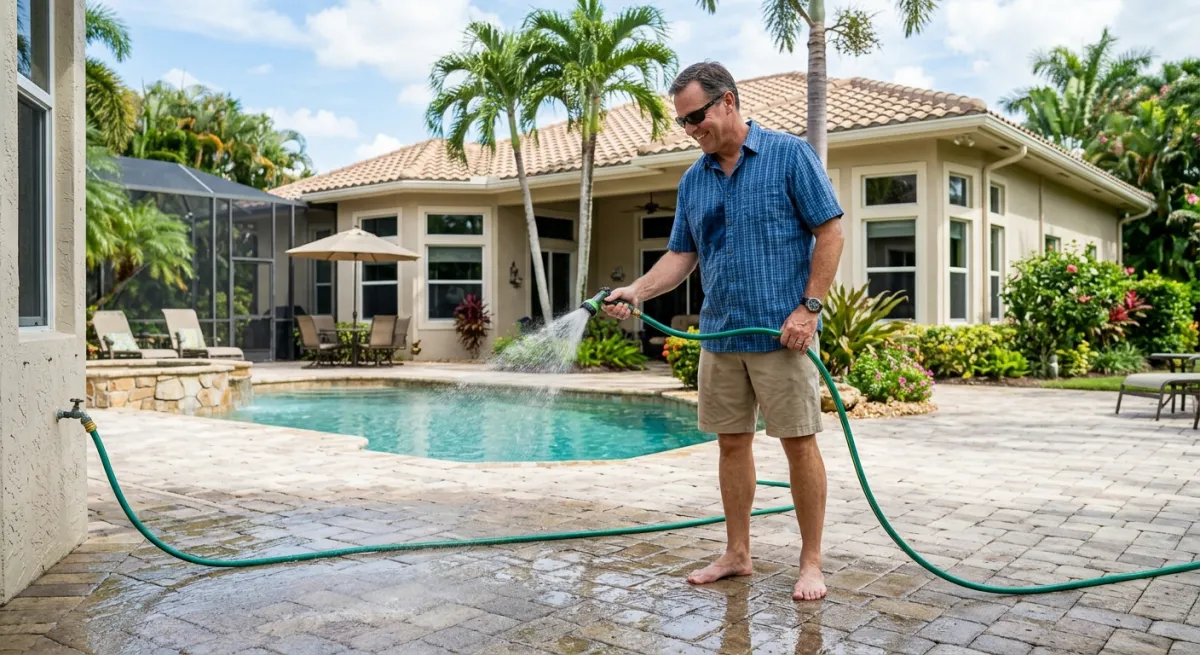
Grab your garden hose -- not a pressure washer -- and rinse off your front walkway, the edges of your driveway near landscaping beds, and your back patio. You're not trying to deep clean anything. You're removing loose dirt, pollen, leaf debris, and that thin layer of organic material that eventually becomes the green or black buildup you hired us to remove.
Focus on:
- The first 2-3 feet of driveway where it meets the lawn or landscaping
- Walkways and front steps where foot traffic concentrates
- Patio surfaces around furniture and planters
- The base of exterior walls where dirt splashes up from rain
Clear Gutters of Loose Debris
You don't need to do a full gutter cleaning every month, but spend five minutes checking for obvious blockages. In Palm Beach County, between the royal palms dropping fronds, the live oaks shedding leaves, and afternoon thunderstorms dumping everything into your gutters, things pile up fast.
A clogged gutter doesn't just cause water damage to your fascia and soffit -- it creates standing water that breeds mosquitoes and accelerates algae growth on your roof edges. A quick visual check and clearing obvious blockages prevents cascading problems.
Spray Down Your Screen Enclosure (If You Have One)
If you've got a screened-in patio or pool enclosure -- and here in South Florida, most of us do -- give it a rinse from the outside with your garden hose once a month. Pollen, dust, and cobwebs accumulate on screen mesh surprisingly fast.
Stand outside and spray from top to bottom at a gentle angle. You'll be amazed at how much comes off. This keeps the screen looking clean and, more importantly, prevents organic material from building up to the point where it stains the aluminum frame.
Quarterly Tasks: A Little More Effort, A Lot More Impact
Every three months, set aside an hour for these deeper maintenance tasks. They require a bit more attention but make a noticeable difference.
Spot-Treat Visible Mold on Walls
When you start to see those first green or dark spots appearing on your exterior walls -- usually on the north-facing side or under eaves where shade keeps things damp -- you can treat them before they spread.
Safe products for homeowner use:- 30-second Outdoor Cleaner (available at Home Depot and Lowe's) -- spray on, let sit, rinse off. It's bleach-based but diluted appropriately for occasional homeowner use.
- Wet & Forget -- a spray-and-walk-away product that works slowly over several weeks. Good for mild growth on walls and fences.
- Simple Green Outdoor Cleaner -- gentler option that works on light surface grime.
- Straight bleach -- it works in the short term but damages paint, kills landscaping, and can etch certain surfaces. The concentration is almost always wrong when homeowners mix their own.
- Muriatic acid -- this is for very specific professional applications. It will permanently damage concrete, pavers, and pretty much any surface if used incorrectly.
- Any product labeled "industrial strength" -- these are formulated for professional equipment with controlled application. Spraying them from a garden sprayer usually results in uneven application and surface damage.
Clean Outdoor Furniture
Your patio furniture collects the same grime that builds up on your house. A quarterly wipe-down with mild soap and water keeps it looking good and prevents organic growth from permanently staining cushion fabric and aluminum frames.
Pull cushions off and brush away loose debris. Wipe down frames with soapy water. For stubborn spots on aluminum or vinyl, a paste of baking soda and water works well without scratching surfaces.
Inspect Caulking and Seals
Walk around your home and check the caulking around windows, doors, and where different materials meet (like stucco meeting trim). Palm Beach County's heat and UV exposure breaks down caulk faster than you'd expect.
Cracked or missing caulk lets water behind surfaces, which creates hidden mold problems and can lead to expensive repairs. Catching and fixing a caulk gap early is a $5 tube of exterior caulk. Catching it late can be a $5,000 repair.
The Garden Hose vs. Professional Equipment Reality Check
Let's talk about what your garden hose can and cannot do, because this is where homeowners get into trouble.
What a Garden Hose Handles Well
- Rinsing loose surface debris -- dirt, pollen, leaf stains that haven't set
- Washing down screen enclosures from the outside
- Rinsing patio furniture and planters
- Keeping walkways clear of loose organic material
What Requires Professional Equipment
- Embedded algae and mold -- once it's rooted into a surface, a hose won't touch it. Professional soft washing uses specialized solutions that kill growth at the root, combined with appropriate pressure to remove it completely.
- Concrete and paver cleaning -- those dark stains on your driveway need 3,000+ PSI with a surface cleaner attachment. Your garden hose can't come close.
- Roof cleaning -- this always requires professional soft washing. Never, ever get on your roof with a pressure washer or even a strong hose. The damage potential (both to you and the roof) is enormous.
- Stucco and painted surfaces -- these need carefully controlled pressure and the right cleaning solution. Too much pressure blasts off paint. Wrong chemicals discolor stucco.
- Gutter brightening -- those black streaks running down the outside of your gutters are oxidation and tiger striping. No amount of garden hose rinsing will remove them.
The Maintenance Hierarchy: Where to Focus Your Effort
Not all surfaces benefit equally from regular homeowner attention. Here's how to prioritize when you've only got 30 minutes:
High Priority (Biggest Bang for Your Buck)
1. Walkways and front entry -- this is what you and every visitor see first. A quick rinse keeps it presentable. 2. Screen enclosure -- screens look dirty fast and clean up easy. Major visual impact for minimal effort. 3. Back patio -- you use this space daily. Keeping it rinsed makes it more enjoyable.
Medium Priority
4. Driveway edges -- the center takes care of itself somewhat through vehicle traffic. The edges near landscaping collect the most growth. 5. Outdoor furniture -- quarterly cleaning prevents permanent staining. 6. Exterior wall spot-treatment -- catching mold early prevents it from becoming a bigger job.
Lower Priority (Leave to Professionals)
7. Roof -- don't touch it. Seriously. Wait for your annual or biannual professional soft wash. 8. Gutter exteriors -- cosmetic tiger striping requires professional products and techniques. 9. Pool deck deep cleaning -- the anti-slip texture on pool decks traps grime in ways a garden hose can't address.
Setting Up a Maintenance Reminder System
The hardest part of home maintenance isn't the work -- it's remembering to do it. Here's what works for our customers:
Monthly reminder (first Saturday):- Set a recurring phone reminder for the first Saturday of each month
- Label it "30-min exterior rinse"
- Keep your hose accessible (not buried behind pool equipment)
- Set reminders for the first weekend of these months
- Label it "1-hour exterior maintenance"
- Keep your spot-treatment products in one accessible location
- Most Palm Beach County homes benefit from professional cleaning 2-3 times per year
- Schedule these during the dry season (November through March) when possible
- Book at least 2-3 weeks in advance during peak season
The Honest Truth About DIY vs. Professional Cleaning
I'm going to be straight with you because I'd rather have a customer who trusts us than one who's confused about what they need.
DIY maintenance extends the time between professional cleanings. If your home typically needs professional attention every 6 months, regular DIY maintenance might stretch that to 8-10 months. That saves you money and keeps your home looking better year-round. DIY maintenance does not replace professional cleaning. No amount of garden hose rinsing will remove embedded mold, deep algae staining, or roof algae. The organisms that grow on South Florida homes are resilient -- they need professional-grade solutions and equipment to fully eliminate.The ideal approach is a partnership: you handle the light monthly and quarterly maintenance, and we handle the deep cleaning 2-3 times per year. Your home stays consistently clean instead of cycling between "just cleaned" and "desperately needs cleaning."
What Good Maintenance Looks Like Over a Year
Here's a realistic timeline for a well-maintained Palm Beach home:
- Month 1: Professional cleaning (everything looks perfect)
- Months 2-3: Monthly rinses keep things looking 90% as good
- Month 4: Quarterly deep maintenance + monthly rinse (still looking great)
- Months 5-6: Monthly rinses (slight buildup starting, but nothing dramatic)
- Month 7: Professional cleaning again (quick job because buildup is minimal)
- Months 8-12: Repeat the cycle
Your Maintenance Game Plan Starts Now
Whether we cleaned your home last week or you're thinking about scheduling your first professional cleaning, building a simple maintenance routine makes everything easier and more cost-effective. Your home stays cleaner, your professional cleanings go faster (and often cost less because there's less buildup to remove), and you get to enjoy a consistently great-looking property.
Need a professional deep clean to establish your baseline? Get your free quote from Crouching Tiger Exterior Cleaning and let's get your home to a place where monthly maintenance is all it takes to keep things looking sharp.